 
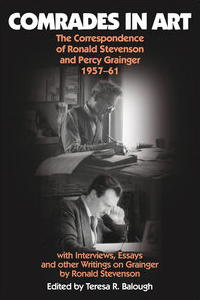
 Comrades in Art
Teresa R Balough, editor
ISBN: 978-0-907689-67-6
hardback
Number of pages: 284 pages, 45 b/w illustrations
Chapters: 23
© 2010 Ronald Stevenson and The Estate of Percy Aldridge Grainger
2010 Teresa Balough (commentary and annotations)
Reviewer: Robert Anderson
Review of Comrades in Art published on 7 December 2010
Comrades in Art - The Correspondence of Ronald Stevenson and Percy Grainger, 1957-61, with Interviews, Essays and other Writings on Grainger by Ronald Stevenson
Contents
Illustrations
Introduction: Percy Grainger and Ronald Stevenson - 'Camerado, I Give You My Hand!' (Teresa Balough)
Acknowledgements
Part I: An Interview with Ronald Stevenson (November 1998)
Part II: The Correspondence
Part III: Stevenson's Writings on Grainger: 1966-2005
- Preface to 'The Young Pianist's Grainger'
- Music's Mowgli
- Random Relics of Percy Grainger
- Kicking into Space: A Portrait of Percy Grainger
- Grainger and the Interaction of Australian and Scottish Cultures
- Percy Grainger and his Circle
- Bach and Wagner: A Journey in Music
- Grainger and the Piano
- Grainger: A Celtico-Nordic Alternative to Graeco-Roman Aesthetics
- Grainger's Transcriptions
- 'In Dahomey': An Editorial Note
- Thoughts on Whitman and Grainger
Part IV: Another Interview with Ronald Stevenson (July 2005)
Appendix: Grainger in Ronald Stevenson's Output
Bibliography
Index of Grainger's Compositions
General Index
Audio CD: Ronald Stevenson's 'An Evening with Percy Grainger'
In 1957 the Australian-American composer Percy Grainger, then 75 and in failing health, received a letter from another pianist-composer, the young Ronald Stevenson, writing from his home in West Linton, below Edinburgh. That first contact – requesting Grainger’s reminiscences of Ferruccio Busoni, with whom he had studied – led to an exchange of 32 letters over the four years before Grainger’s death in February 1961.
The two men soon found that, despite their 46-year age-difference, they had many affinities. Both were pianists of staggering abilities and composers who combined a love for folk-music and working-class art with an aesthetic that proposed a ‘world music’ to include the farthest reaches of humanity. Both made an art of piano transcription of a wide variety of works and were champions of little-known music and composers. And both revered the work of Walt Whitman, that great poet of inclusivity, the pioneering spirit and the open road.
This book presents both the complete Grainger-Stevenson correspondence and Ronald Stevenson’s many articles and lectures on Grainger and his music, edited by Teresa Balough, whose two interviews with Stevenson open and close the volume – which includes a CD of a lecture-recital on Grainger that Stevenson presented in Grainger’s home in White Plains, New York, in 1976.


|
|
|